Lesson 1: Terms & Supplies
[HOME]
[PART 1-THE BAISCS] L1: Terms & Supplies * L2: The Strum * L3: The 5 Basic Chords * L4: Playing 1st Song
[PART 2: DIGGIN’ IN] Guitar Tuning * Music Theory * Transpose * More Chords
[PART 3-PLAYING BASS] Playing Bass.
[PART 4-SONGS] Songs
Know Your Guitar
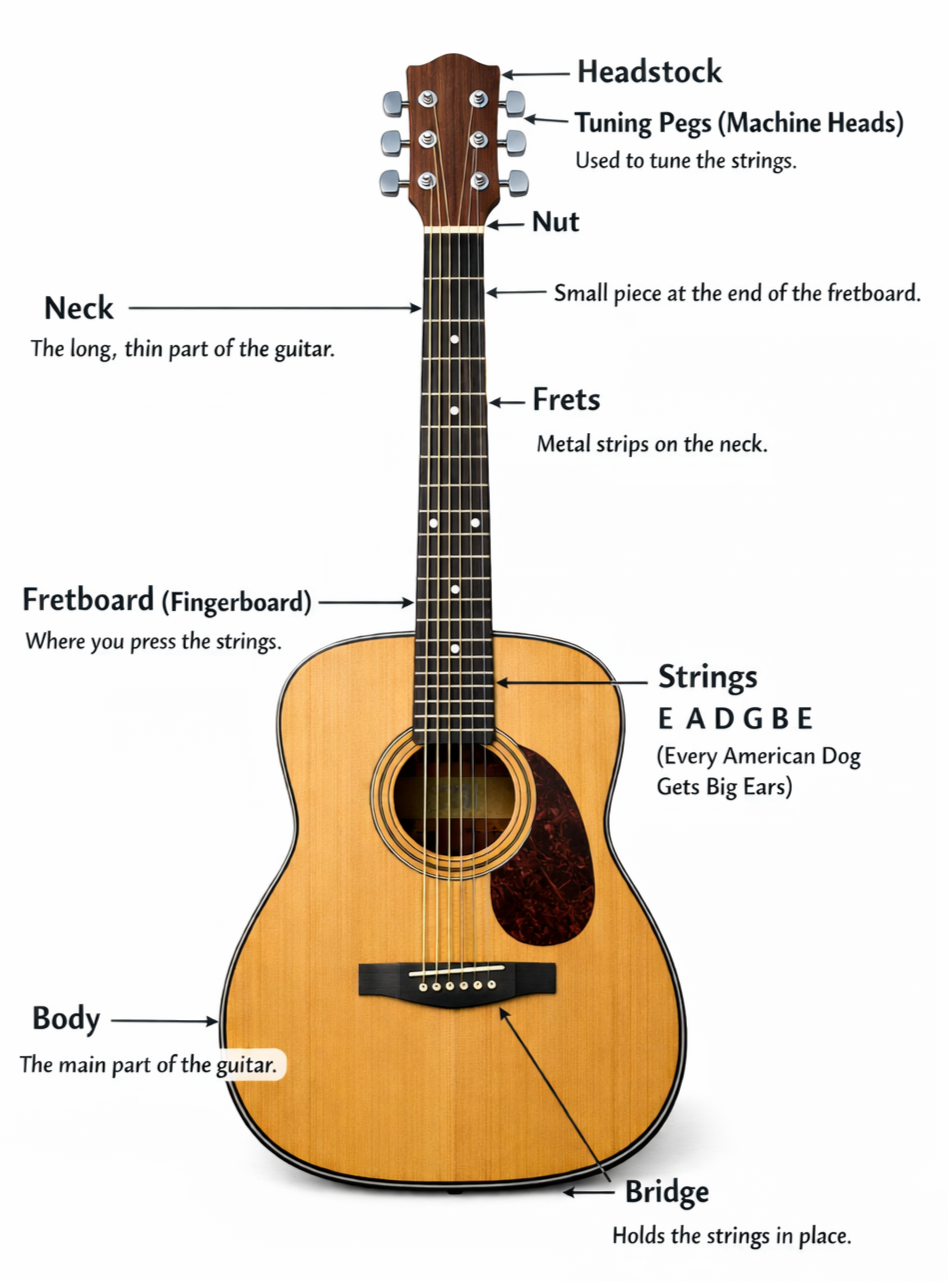
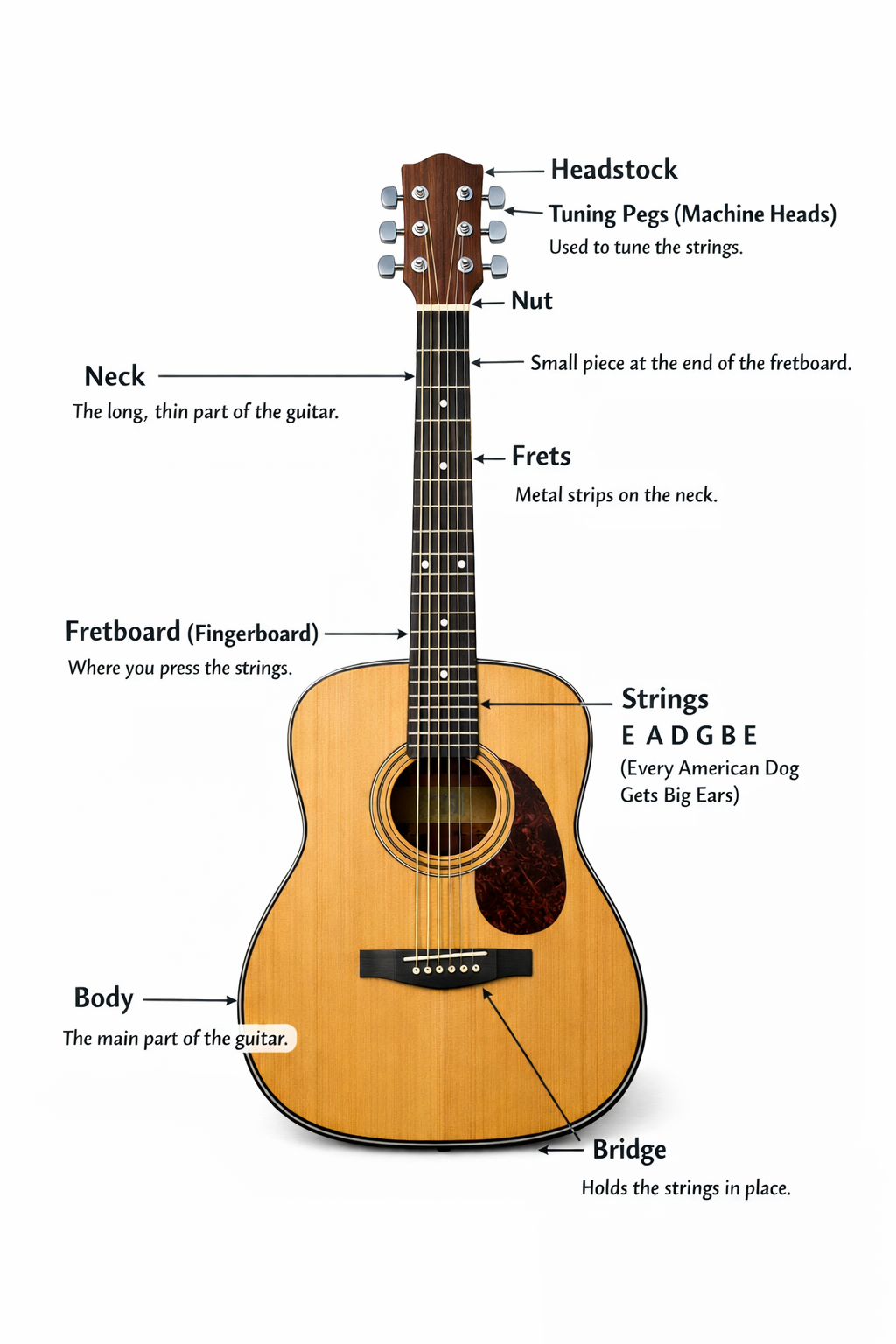
Neck: The long, thin part of the guitar that extends from the body. It has the frets and is where you press down on the strings to change their pitch.
Headstock: The end of the neck where the tuning pegs are located. It holds the strings in place and helps to tune the guitar.
Tuning Pegs (or Machine Heads): Small knobs located on the headstock that you turn to adjust the tension of each string and tune the guitar.
Frets: Metal strips embedded along the neck. Pressing the strings down just behind these strips changes the pitch of the notes.
Fretboard (or Fingerboard): The flat part of the neck where you press the strings. It's covered with frets.
Strings: The thin, metal wires or plastic (classical) with varied thickness stretched along the neck and body. They produce sound when plucked or strummed. (The strings (starting at the top with the thickest string) are tuned to the notes E-A-D-G-B-E. You can remember these notes with the phrase (from top to bottom) Every American Dog Gets Big Elephants OR (from bottom to top) “Easter Bunnies Get Down After Easter.”
Bridge: A grooved part on the body (near the soundhole or in the middle of the body) where the strings are anchored. It helps transfer the vibration of the strings to the body of the guitar.
Nut: The small piece at the end of the fretboard, just before the headstock, that holds the strings in place and maintains their spacing. The sound comes from the strings vibrating from the Bridge to the Nut.
More Terms to Know
Pickups: (For electric guitars) Magnetic devices located under the strings that capture the vibrations and convert them into electrical signals to be amplified.
Soundhole: (For acoustic guitars) The hole in the body that allows sound to project from inside the guitar.
Pickguard: A protective plate on the body of the guitar that guards against scratches from strumming or picking.
Controls: (For electric guitars) Knobs and switches that adjust the volume, tone, and pickup settings.
Capo: A device one attaches on the neck of the guitar, across all six strings of the guitar that uniformly raises the pitch (sound tone) of all six strings on your guitar.
Pick: Either a plastic or nylon thin striking piece, used in strumming and picking.
Strum: Stroking the strings with a "pick" in a rhythmic manner to create sound.
Supplies
Picks - Thin pieces of plastic (or other materials) used to strum or pluck the guitar strings. (These are the ones I use.)
Tuner - A device that helps you adjust each string so the guitar plays the correct notes. You can use a phone app or buy an electronic one like the one I have. Some guitars have a tuner built into the guitar.
Capo - A clamp that attaches to the guitar neck to raise the pitch of all the strings, allowing you to play in different keys using the same chord shapes. Here is a basic one that would get you started.
Guitar stand - it’s nice to have a guitar stand to hold your guitar when not playing for a moment
Guitar (classical, 6-string, 12-string, electric, bass). Go to a music shop like Guitar Center and try out several guitars
Classical often has plastic strings and a wider neck
6 or 12-string acoustic - Check the body size and the action on the strings (how hard it is to push down)
You can get either electrified so you can play with a band in the future-RECOMMENDED-or not.
You can get a guitar with an onboard tuning system
Electric - you will need to purchase an amp. (You will get what you pay for)
Bass - you may want to learn bass also or instead of. It usually has 4 strings.
Guitar Case (soft, hard) - hard will protect your guitar and the tuning of the guitar better
Strings (classical, 6-string, 12-string, electric, bass)
Aoustic 6-string.
I use Martin Light (model number MA540T). String gauges: .012, .016, .025, .032, .042, .054 (Buy in bulk-3 pk- is cheaper.)
Ernie Ball’s Earthwood Medium Light Phosphor Bronze Acoustic Guitar Strings, 12-54 Gauge (P02146) are cheaper and just as good.
String changer - A small tool that helps you remove old guitar strings and install new ones more quickly and easily.