More Chords
[HOME]
[PART 1-THE BAISCS] L1: Terms & Supplies * L2: The Strum * L3: The 5 Basic Chords * L4: Playing 1st Song
[PART 2: DIGGIN’ IN] Guitar Tuning * Music Theory * Transpose * More Chords
[PART 3-PLAYING BASS] Playing Bass
[PART 4-SONGS] Songs
More Chords
Guitar Chords by Key (G, C, D, A) - I, ii, iii, IV, V, VI
Guitar Chords for Beginners. This chart has more chords
All Guitar Chords - You can select what chord you want to make on the guitar, and it will show you.
Barre Chords
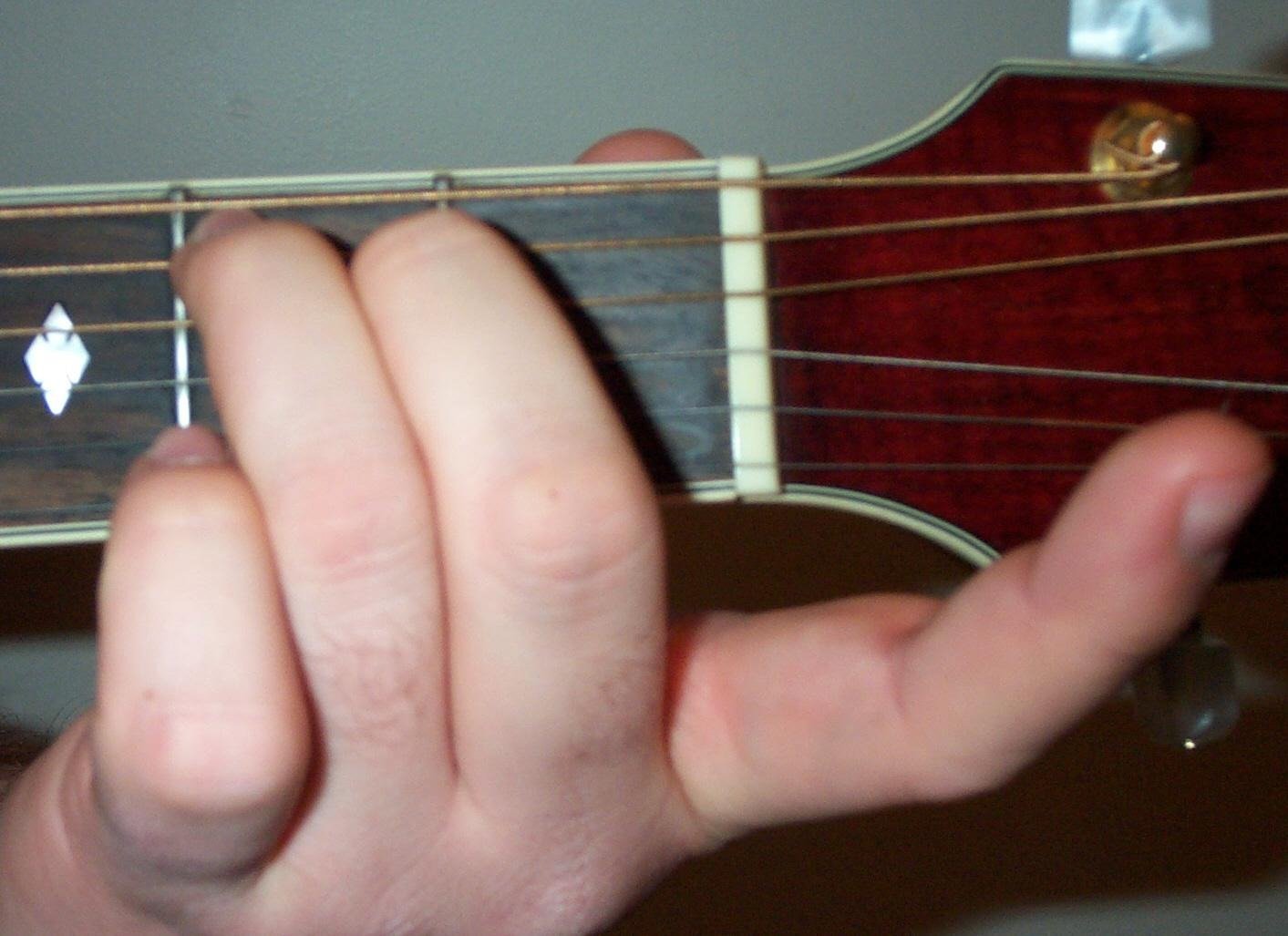
Barre chords are chords that can be formed so you can slide up and down the neck. The index finger works as a human capo, and then a chord is formed with the other fingers. In the picture (right), my finger is up. But if I placed my index finger down on the first fret, pushing down all the strings, I have just done what the capo did. Once a chord is made, then it can be moved up the neck, and the chord changes pitch as your finger passes each fret.
Remember how to make an Em? (Look back at the picture.) Make an Em, then place your index finger on the first fret. Press all the strings down. Your finger has become the nut, or the outside point for the sound to be made on the strings. Because you “moved the nut one fret up the neck, you then need to move your Em finger position up the neck. By having the index finger on the first fret, the second fret is open, the 3rd fret has your middle and ring fingers on the 4th and 5th string, and you have created a new chord. Instead of playing an Em, you are now playing the chord a ½ step higher or Fm (remember the steps? There is no E#. From E, there is only a ½ step to F. The same goes for B to C). Move that position (index, space, and middle and ring fingers) up one more fret, and you have an F#m. Move one more fret up, and you have a Gm. It is a minor chord because you started with Em. Start with an E (see chord chart), and you would move to an F, then to an F#, and on to a G, etc.
Now make an Am with your middle, ring, and pinky fingers. Slide that position up one fret and barre the first fret with your index finger, and you have made a Bbm (The lower case b is for a flat. Bb or flat is the same thing as A# or sharp.). Move it one more up, and you have a Bm. One more and you are playing Cm.
Look at your chord chart in the back of the book and make an A chord with your last three fingers, instead of what is suggested. Barre the 1st fret, skip a fret, and make an A chord. You have just formed a Bb (flat). Move up one more, and you make a B chord. Keep practicing. You’ll need to get these barre chords down sometime.
These kinds of positions can be used for many chords, and then you can move up and down the neck, hitting chords fast.
One thing you will quickly discover is that barre chords are hard. You have to get your fingers to do some “workouts” to get strong enough to press down hard enough to make barre chords sound good. But work hard. You will move your guitar playing to the next level!
Watch this video on playing Barre Chords
PLAY GUITAR: [HOME] Playing Bass